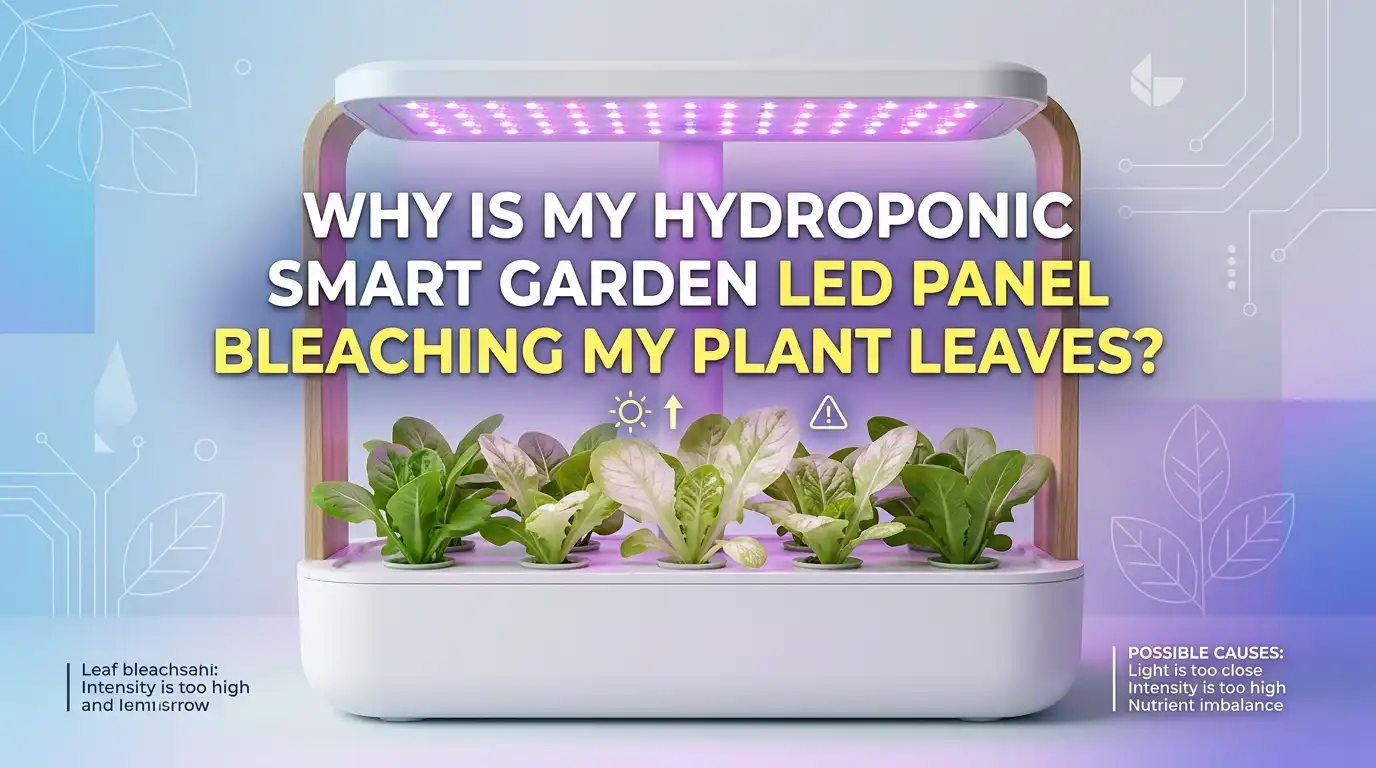
Why Is My Hydroponic Smart Garden LED Panel Bleaching My Plant Leaves?
If your hydroponic smart garden looks healthy one week and then suddenly shows pale, washed out, or almost white leaves, the LED panel may be the real problem.
Many growers first blame nutrients, root disease, or bad seeds. In many cases, the cause is much simpler. The light is too close, too strong, on for too long, or all three at once.
The good news is that leaf bleaching is usually a fixable stress signal, not the end of your crop. Your plants are asking for a better light setup.
In a Nutshell
- Leaf bleaching usually means the plant got more light than it could use. The chlorophyll in the leaf starts to break down. The leaf loses green color. Then it looks pale, cream, yellow white, or faded. If the stress continues, the tissue can turn dry and brittle.
- Distance matters more than many people think. In many smart gardens, the LED panel sits very close to the canopy. That sounds efficient, but it can push the top leaves into stress fast. A few extra inches can make a real difference.
- Daily light dose matters just as much as brightness. Herbs and leafy greens often do well with a moderate daily light target. Many home setups work best around 12 to 14 hours a day, and going beyond 16 hours can create more stress than growth.
- Bleaching does not always mean a nutrient problem. Nutrient issues often show a pattern across old or new leaves based on the element involved. Light stress usually hits the topmost leaves first, especially the ones closest to the panel. That pattern helps you diagnose the issue faster.
- A simple recovery plan works best. Raise the light if you can. Shorten the timer. Improve airflow. Keep water and pH steady. Remove only the leaves that are badly damaged. Do not change ten things at once. Small, calm adjustments help you see what is working.
- Prevention is easier than repair. Once a leaf is fully bleached, it rarely turns deep green again. The goal is to protect new growth. If new leaves come in normal and healthy, your fix is working. That is the sign to watch.
What Leaf Bleaching Looks Like in a Hydroponic Smart Garden
Leaf bleaching is easy to confuse with yellowing, nutrient stress, or natural aging. The key difference is the color pattern and the location on the plant.
In most smart gardens, the top leaves closest to the LED panel fade first. They may look light green at first, then creamy, pale yellow, or almost white. The color often looks washed out rather than spotted.
As the stress continues, the surface can feel thin, dry, or papery. In stronger cases, the faded areas later turn brown and crisp. This is why many growers call it light burn, even when heat is not the main cause.
Pros of spotting it early are fast correction and less crop loss. Cons of waiting too long are slow recovery and ugly new growth. If only the upper canopy shows damage while lower leaves stay greener, excess light is a very strong suspect.
Why Smart Garden LEDs Can Bleach Leaves Faster Than You Expect
Smart gardens make indoor growing easy, but they also create a very specific lighting setup. The LED panel is usually fixed above a small growing area.
Reflective surfaces bounce light back into the canopy. The timer may run for long periods. All of that can push plants into stress faster than you expect, especially leafy herbs like basil, lettuce, dill, and parsley.
A plant can only use so much light at one time. After that point, extra light stops helping and starts causing trouble. The leaf absorbs more energy than it can process. Then chlorophyll breaks down, and the leaf fades.
This is why a plant can bleach under LEDs even if the panel does not feel hot to your hand. Pros of smart garden LEDs are strong growth and compact form. Cons are short panel distance, long default schedules, and very little room for the plant to escape intense light.
Check the Light Distance First
If your smart garden allows height adjustment, this is the first fix to try. Light intensity rises fast at close range. A small change in distance can lower stress without changing anything else. That matters because the top canopy in a smart garden often grows right into the strongest part of the beam.
Start by raising the panel a little and watch new growth for several days. If your model does not let you raise the panel much, lower the plant platform if possible, trim the tallest stems, or move the most sensitive plant to a lower spot in the pod layout.
Pros of increasing distance are quick relief and no extra cost. Cons are slightly weaker light at the edges and slower growth if you move too far away. The goal is balance, not darkness. A little extra space often solves bleaching faster than a full nutrient reset.
Fix the Daily Light Dose Before You Change Nutrients
Many indoor growers focus only on brightness, but plants respond to the total light they receive each day.
That total matters a lot in a smart garden because the timer often runs every day with very little variation. For herbs and leafy greens, a moderate daily dose usually works better than a constant maximum push.
A practical starting point is 12 to 14 hours of light a day. Many home gardeners also keep lights within a wider 10 to 16 hour range, but more time is not always better.
Leafy crops often perform well at a daily light target around 12 to 16 mol per square meter per day. Lettuce also tends to do well around 250 to 350 micromoles per square meter per second rather than extreme intensity.
Pros of reducing hours are easy setup and fast stress relief. Cons are slightly slower growth for very light hungry crops. For bleached leaves, relief matters more than speed.
Match the Light to the Plant You Are Growing
Not every plant in a smart garden wants the same light dose. Basil can handle more light than many tender lettuces. Baby greens often bleach faster than sturdier herbs.
Seedlings also need gentler light than mature plants. If you grow mixed crops under one panel, the most sensitive plant usually sets the limit for the whole garden.
This is why one pod may thrive while another looks faded. The LED is not always wrong. It may just be wrong for that crop at that stage. If your garden mixes lettuce, basil, and small herbs, place the tougher plants in the strongest center zone and the sensitive ones near the edge.
You can also harvest tall crops sooner to protect shorter neighbors. Pros of crop matching are better canopy balance and fewer stress symptoms. Cons are less freedom in pod placement and more planning. It is worth it if bleaching keeps returning.
Learn the Difference Between Light Stress and Nutrient Deficiency
Light bleaching and nutrient deficiency can look similar from a distance. You need the pattern, not just the color. Light stress usually appears on leaves nearest the LED panel. The tops fade first.
The damage may look broad and washed out. Nutrient issues often follow a different pattern. Some affect old leaves first. Others affect new leaves first. Many cause edge burn, spotting, or vein changes.
If your roots look healthy, your water level is steady, and only the highest leaves are turning pale, start with the light before you change feed strength. Too many growers add more nutrients to a light problem and make the plant even more stressed.
Pros of checking the pattern first are fewer wrong fixes and faster recovery. Cons are that mixed problems can still happen. A plant under excess light may also use water faster and drift into pH or nutrient imbalance later.
Lower Heat Stress Around the Canopy
LED panels run cooler than older grow lights, but cooler does not mean cool. In a small smart garden, even mild heat can build up around the top leaves. Warm air trapped under the panel can make bleaching worse, especially if the room is already warm or the water reservoir dries down too fast.
Feel the space around the canopy, not just the panel. If the top leaves feel warm and the air sits still, improve air movement in the room. A gentle fan nearby can help, even if it does not blow straight at the plants.
Also keep the reservoir topped up so roots do not face dry periods. Pros of better airflow are lower leaf temperature and stronger stems.
Cons are faster water loss and the need to monitor the tank more often. Light stress and heat stress often team up, so cooling the space can reduce bleaching even before you change the timer.
Reset a Bleached Plant Step by Step
When bleaching starts, use a calm reset plan. Do not panic and replace nutrients, pods, water, and timer all on the same day. That makes it hard to tell what helped.
First, reduce light stress. Raise the panel if possible, shorten the timer, and improve airflow. Next, check reservoir level and pH. Then wait and watch new growth.
Do not expect damaged leaves to turn fully green again. The real test is the next set of leaves. If new growth comes in deeper green and more normal in shape, your fix is working.
Remove only the leaves that are badly damaged or clearly dying. Pros of a step by step reset are clear results and less plant shock. Cons are that recovery looks slow at first. Plants heal forward, not backward. Give them a week of stable conditions before you judge the outcome.
Harden Plants to Brighter Light Instead of Forcing Full Power
Plants need time to adapt to stronger light. This matters after germination, after pruning, after moving a plant into an empty spot, or after replacing a weak crop with a fresh seedling. Tender new tissue can bleach under a light level that older leaves handled well last week.
Use a simple hardening plan indoors. Run a shorter light day for several days, then slowly add time. If your unit has brightness control, start lower and increase it in steps. If it does not, increase distance early and bring the light closer only if the plant stays healthy.
Pros of gradual light increase are less shock and stronger new growth. Cons are slightly slower early growth and a need for patience. This method is especially useful for lettuce and young herbs, which can react fast to sudden intensity even in a small countertop garden.
Keep Water, Nutrients, and pH Steady During Recovery
Bleaching often begins with light, but unstable root conditions make recovery harder. A stressed plant uses water differently. The reservoir can drop faster.
Nutrient concentration can shift. pH can drift out of range. Then the plant starts showing a second problem on top of the first one.
During recovery, aim for boring consistency. Keep the water level steady. Mix nutrients at the normal rate for your crop rather than pushing extra feed. Check pH and keep it in the normal hydroponic range your crop prefers.
If the solution is old, replace it with fresh balanced feed instead of adding random supplements. Pros of steady root care are easier recovery and better new leaf color.
Cons are that it takes regular checking. Light damaged plants do best under simple, stable conditions. They do not need miracle fixes. They need fewer stress signals at the same time.
Compare the Best Fixes for Your Setup
You do not need every possible fix. You need the best one for your type of smart garden. If your unit has a movable panel, raising the light is usually the fastest answer.
Pros are speed and simplicity. Cons are reduced intensity if you go too far. If the panel is fixed, shortening the timer is often the next best tool. Pros are easy control and zero cost. Cons are slower growth if the schedule becomes too short.
If your garden has dimming, use that with small adjustments. Pros are precision and flexibility. Cons are that many small gardens do not offer it. If heat is part of the problem, better room airflow helps.
Pros are cooler leaves and stronger stems. Cons are more evaporation. For most growers, the winning combo is simple: a little more distance, a shorter light day, and stable reservoir care.
How to Stop LED Bleaching From Coming Back
Prevention starts with observation. Look at the top canopy every day, even for thirty seconds. New pale growth near the panel is your early warning. If you act at that stage, you can usually stop the problem before the leaves turn white and brittle.
Keep a simple routine. Prune tall growth before it touches the panel. Rotate crops by height if your pod layout allows it. Use a timer that fits the crop instead of running a fixed long schedule forever.
Recheck the light any time you change crop type, add seedlings, or move the garden to a warmer room.
Pros of prevention are better harvest quality and fewer emergency fixes. Cons are only that you need regular attention. A smart garden is easy, but it is still gardening. The best results come from small adjustments made at the right time.
FAQs
Can bleached leaves turn green again?
Usually, no. A fully bleached leaf rarely returns to a rich green color because the chlorophyll has already been damaged. You may see slight improvement if the fading was mild, but badly washed out tissue usually stays pale. Focus on new growth, because that is the best sign of recovery. If new leaves come in healthy, your changes are working.
How many hours should I run my smart garden light?
A good starting point for many herbs and leafy greens is 12 to 14 hours a day. Many home growers stay within 10 to 16 hours, but the higher end can stress plants if the panel is close and intense. If you already see bleaching, reduce the schedule first and then watch the next few days of growth.
Should I flush the nutrients if leaves look white?
Not right away. If the top leaves nearest the panel are bleaching, the light is often the first problem to fix. Check distance, timer, and heat before you change the reservoir. A full flush can help only if your solution is clearly old, too strong, or out of balance. Random flushing does not solve excess light by itself.
Which plants bleach fastest in a small smart garden?
Tender lettuces, baby greens, and young seedlings often bleach faster than tougher herbs. Basil can take more light than many salad greens, but it can still bleach if the panel sits too close for too long. Mixed plantings are common trouble spots because one crop may love the light level while another struggles under the same panel.
Is bleaching caused by heat or by light?
It can be both. Excess light can break down chlorophyll even if the panel is not very hot. At the same time, warm still air around the canopy can make the stress worse. That is why the best fix often combines less light pressure with better airflow and stable water in the reservoir.
What is the fastest fix I can try today?
Raise the panel if your unit allows it. If not, shorten the timer and trim the tallest growth away from the light. Then top up the reservoir and improve airflow around the garden. Those changes are simple, safe, and often effective within days. Watch the newest leaves, because they will show the result before the old damage disappears.

Hi, I’m Sonny Dawson, the creator and voice behind ConvertResizeGen. 👋 I’m a passionate tech enthusiast who loves exploring the latest gadgets, devices, and electronics that shape the way we live and work. Through my website, I share honest, hands-on reviews of trending Amazon products to help you make smarter buying decisions.