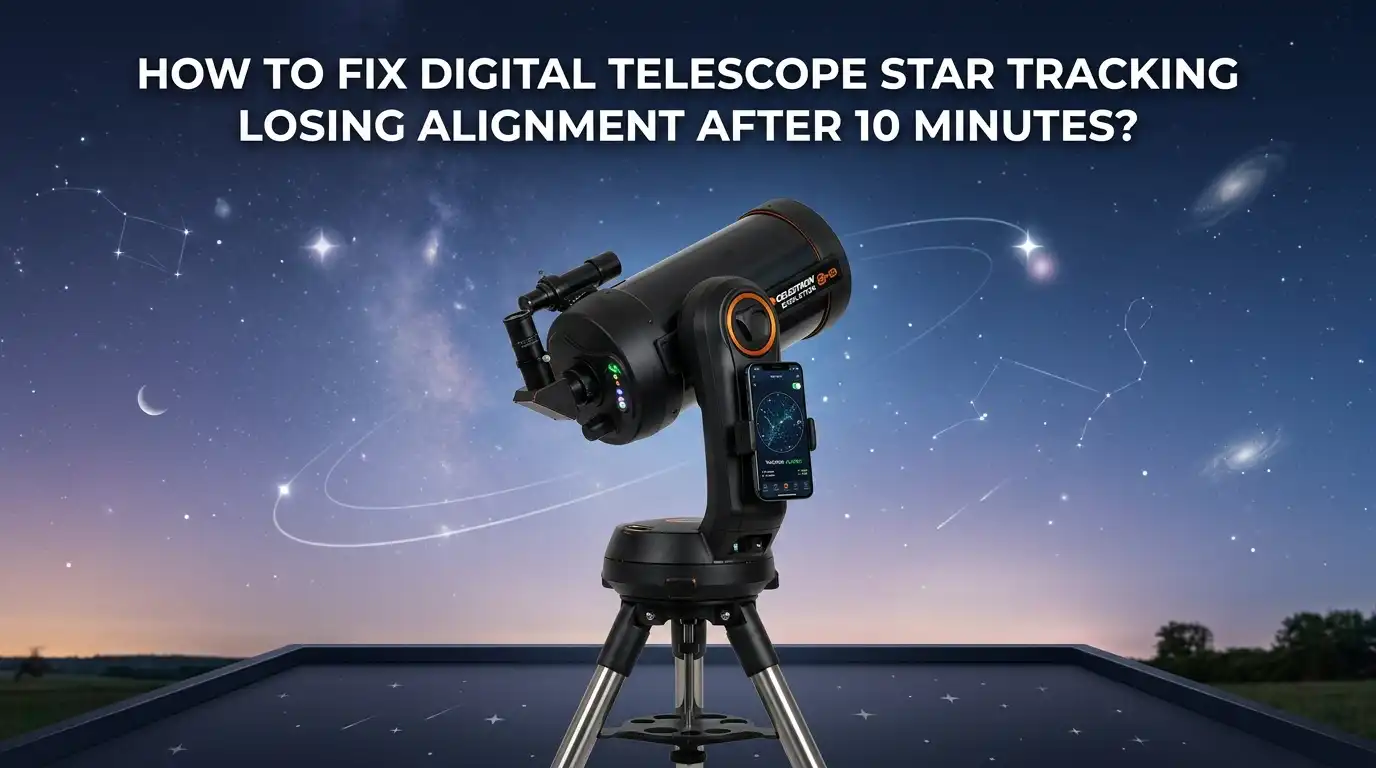
How To Fix Digital Telescope Star Tracking Losing Alignment After 10 Minutes?
If your digital telescope tracks well at first and then starts drifting after about 10 minutes, you are not alone. This problem usually comes from a small setup error, not a broken mount.
The hard part is that several small issues can look the same at the eyepiece or on the camera screen. A wrong tracking rate, weak power, poor polar alignment, field rotation, backlash, bad balance, or loose clutches can all push the target out of place.
The good news is simple. You can fix this by checking the system in the right order. This guide will help you do that without guesswork. Start with the fast checks, move to the alignment fixes, and finish with a short test routine that tells you exactly what changed.
In a Nutshell
- Check the easy settings first. Many tracking problems come from the wrong time, wrong time zone, wrong daylight saving setting, or the wrong tracking rate. For stars and deep sky objects, the mount should usually run at the sidereal rate. If the mount is set to solar or lunar by mistake, drift can show up fast.
- Know what kind of mount you are using. An equatorial mount usually drifts because of polar alignment, balance, backlash, or periodic error. An Alt az mount can keep the target centered for visual use, but long camera exposures can still fail because of field rotation. That means the object may stay near the middle while the stars slowly rotate in the frame.
- Rebuild alignment from zero when needed. If the mount keeps missing after a few minutes, start over with the tripod stable, the home position correct, and bright alignment stars far apart. Rushing the first two stars often creates the next hour of trouble. A clean setup is faster than chasing the same drift again and again.
- Balance and clutch tension matter more than many people think. A slightly bad balance can stress the motor and make tracking uneven. Loose clutches can do the same. Even one cable pulling on the scope can ruin an otherwise good session. This is why a mount can act fine for five minutes, then fail as the scope points to a new part of the sky.
- Mechanical error often shows up on a time pattern. Many worm driven mounts have periodic error that repeats in a cycle close to 5 to 10 minutes. If your stars look fine at first and then drift in a repeating way, the mount may need PEC, guiding, or shorter exposures. This is a fixable pattern, not a mystery.
- Use a simple test routine after every fix. Change one thing, center a star, and watch it for 10 to 15 minutes. That method saves time and tells you which fix actually worked. One clear test is better than five random tweaks.
Start by identifying the exact kind of drift
Before you adjust anything, look at how the target moves. Does the star slide in one steady direction, jump after a button press, or stay centered while the image slowly rotates?
These clues matter. A steady north or south drift often points to polar alignment error on an equatorial mount. A delay after reversing direction often points to backlash. A repeating problem that shows up close to every 5 to 10 minutes can point to periodic error.
If you use a camera, take two or three short test exposures at fixed intervals. Check whether the stars trail in one direction or form small arcs. That pattern helps you separate tracking drift from field rotation. For visual use, place a bright star on a crosshair eyepiece and watch where it moves.
Pros: This method costs nothing and prevents random changes.
Cons: It takes patience, and beginners may need two or three tests before the pattern feels clear.
Check time, location, and tracking rate first
This is the fastest fix, and it solves more sessions than many people expect. Confirm the date, local time, time zone, and daylight saving setting in the hand controller or app.
One wrong time setting can damage both pointing and tracking. If your mount uses saved location data from a past session, make sure it still matches your current site.
Then check the tracking rate. For stars and deep sky targets, use the sidereal rate. Use lunar only for the Moon, and solar only for the Sun with proper solar safety equipment.
A wrong rate can look like bad alignment even when the mount is otherwise fine. Also confirm the correct tracking mode for your mount, such as EQ North, EQ South, or Alt az.
Pros: Fast, simple, and often enough to fix the problem.
Cons: Easy to overlook because the menu looks normal at a quick glance.
Rebuild your star alignment from zero
If the easy settings are correct, redo the full alignment from the start. Put the tripod on firm ground. Level it as well as you can. Return the mount to the correct home position before power on. Then choose bright stars that are far apart in the sky. Wide star spacing helps the mount build a better sky model.
Center each star carefully. Use the finder first, then a higher power eyepiece or a zoom view on the camera. Defocusing the star slightly can make centering easier.
If your controller suggests a final approach direction, follow it the same way each time. Consistency reduces gear slack errors. On some systems, replacing an alignment star later in the night can restore local accuracy.
Pros: Strong fix for bad pointing and weak early tracking.
Cons: It takes a few extra minutes, and sloppy centering can ruin the benefit.
Improve polar alignment on an equatorial mount
If you use an equatorial mount, polar alignment is often the main cause of drift after several minutes. A rough north pointing setup can be enough for casual viewing, but it is rarely enough for stable camera tracking.
Even a small polar error can push the star across the frame during longer tests. That is why a mount can seem fine at first, then slowly lose the target.
Start with a rough polar setup using your latitude and a view near the pole. Then refine it with the mount routine, a polar scope, or drift alignment.
Drift alignment is slow, but it is still one of the best ways to remove stubborn error. If a meridian star drifts north or south, your azimuth is off. If a low eastern star drifts north or south, your altitude is off.
Pros: Best fix for steady drift on EQ mounts.
Cons: Takes longer, and it is harder when the pole is blocked by trees or buildings.
Know when Alt az field rotation is the real issue
Many people think their digital telescope is losing alignment when the real problem is field rotation.
This is common with Alt az mounts. The mount can keep the target near the center for visual use, but the camera frame still rotates as the sky moves. That means stars near the edges start to stretch even when tracking looks okay in the middle.
If your problem appears during imaging, compare a 10 second shot, a 20 second shot, and a 30 second shot. If the center stays close but the edges twist or arc, field rotation is likely the real cause.
For many Alt az deep sky setups, practical exposures stay short. Live stacking works better than one long exposure unless you use an equatorial wedge or move to an equatorial mount.
Pros: Explains why alignment looks good but photos still fail.
Cons: The fix may require shorter exposures or different hardware.
Balance the mount and lock every axis correctly
A mount that is out of balance puts extra strain on the motor and can track unevenly. This can show up after several minutes, especially as the scope points to a different angle.
Check balance in both right ascension and declination for equatorial mounts, or in both movement axes for Alt az systems if your design allows it. The scope should not swing when a clutch is released.
After balance, tighten the clutches fully for motor use. A clutch that feels almost tight may still slip under load. Also check that heavy accessories, dew heaters, cameras, and diagonal changes did not shift the center of gravity.
A small weight change can matter more than it looks. Some imagers prefer a slight east heavy balance on EQ mounts to keep the gears engaged smoothly.
Pros: Very effective and costs nothing.
Cons: Must be repeated after changing accessories or tube position.
Remove backlash and gear slack problems
Backlash is the small delay between motor movement and real scope movement. You notice it when the star lags after you reverse direction.
That lag can hurt centering during alignment and can also create uneven tracking corrections later. Backlash does not always mean the mount is bad. Many mounts have some gear play and need compensation settings.
Test this on a bright star at a slow slew rate. Tap one direction, then reverse. If the star pauses before moving, adjust the backlash settings in the controller or app if your mount offers them.
Some systems also work better when you always finish centering with the same two direction keys. That keeps the gears loaded in a repeatable way. If backlash is severe, inspect worm tension, gear mesh, and clutch tightness.
Pros: Good fix for delayed response and messy alignment centering.
Cons: Too much compensation can cause overshoot and jerky motion.
Fix power drops before chasing deeper faults
Weak or unstable power can make a mount behave in strange ways. Slews may look slow, tracking may become uneven, or the system may keep the object centered poorly after the first part of the session. Some mounts even show a warning light or flashing power indicator when voltage drops. A low battery can imitate many other faults.
Use a stable power source that matches the mount requirement. Check every connector for looseness. Cold weather can reduce battery performance, so a battery that worked in warm air may fail sooner at night.
Also avoid thin, long power cables when possible. Voltage drop across a weak cable is real. If the mount starts acting worse after several slews, test with a known good power supply before touching alignment again.
Pros: Easy to confirm and often ignored.
Cons: Requires a spare power source or meter for the best test.
Stop cable drag, tripod shift, and vibration
A good alignment can still fail if something physical moves the setup. Cable drag is a common reason. As the mount tracks across the sky, one tight cable can start pulling the tube or camera.
The drift may show up only after a few minutes, which makes it easy to blame alignment. Always watch the full cable path during a mock slew.
Check tripod feet, leg locks, spreader tension, and ground firmness. Soft soil, a deck, and even one small bump can shift the whole setup. Wind also matters, especially with long tubes.
If the problem gets worse in gusts, the mount may be fine and the support may be the weak point. Route cables with gentle slack, secure them near the mount, and keep heavy power bricks off the moving parts.
Pros: Cheap fix and very common in real sessions.
Cons: Easy to forget after adding one new camera or heater cable.
Use sync, calibration, PEC, or guiding when your mount supports them
Some drift is not from bad setup. It comes from the mount’s natural mechanical limits. Many worm gear mounts have periodic error that repeats on a cycle close to 5 to 10 minutes. If your star stays close for a while and then drifts in a repeating pattern, this is a strong clue. In that case, advanced tools can help.
Use local sync or replace an alignment star if your target region is off but the rest of the sky is acceptable. Use calibration routines if your system offers mount calibration or cone error correction.
If your mount supports PEC, train it and test again. PEC can smooth repeated worm error. For imaging, guiding with a guide scope or off axis guider can correct small mount mistakes in real time.
Pros: Best option for repeated mechanical error and longer imaging sessions.
Cons: More setup time, more cables, and more settings to learn.
Run a 10 minute verification routine after each fix
Do not make five changes at once. Make one change, then test it. Center a bright star near the celestial equator. Watch it for 10 to 15 minutes with tracking on. If you use a camera, shoot a few short exposures at set intervals and compare them. This turns guesswork into evidence.
A good test order is simple. First, verify time and tracking rate. Second, test balance and clutch tension. Third, rebuild alignment. Fourth, refine polar alignment if you are on an EQ mount.
Fifth, test power and cable drag. Last, decide whether the remaining error looks like periodic error or field rotation. By the end of this routine, the real cause is usually obvious. Keep short notes so you know what improved and what did not.
Pros: Saves time in the long run and gives clear answers.
Cons: Requires discipline, especially when you want a quick fix right away.
Build a reliable pre session checklist
The best cure for losing alignment after 10 minutes is to stop the problem before it starts. Create a simple checklist and follow it every night.
Confirm the tripod is stable, the mount is level enough, the time data is correct, the location is correct, the tracking rate is sidereal for stars, the scope is balanced, the clutches are tight, and the cables hang freely. A two minute checklist can save a whole night.
Add one line for your mount type. If it is equatorial, include polar alignment and a quick drift test if needed. If it is Alt az, include your maximum exposure time and stacking plan. This prevents you from asking the mount to do a job it cannot do cleanly. With repeatable setup habits, your telescope starts acting repeatable too.
Pros: Reduces future failures and lowers stress.
Cons: Feels boring at first, but it pays off very fast.
FAQs
Why does my telescope stay accurate for a few minutes, then drift later?
That usually means the error is small at first and grows with time. Common causes are poor polar alignment, wrong tracking rate, cable drag, weak power, or periodic error in the worm gear. If the problem repeats on a time pattern, periodic error is a strong suspect. If the drift is steady in one direction, check alignment and settings first.
Can a bad alignment still happen if the GoTo looked correct at the start?
Yes. GoTo accuracy and long tracking accuracy are related, but they are not the same thing. A mount can place the object near the target at the start, then still drift because of polar error, field rotation, or power issues. Good pointing is helpful, but it does not prove the full tracking system is clean.
What is the first thing I should change tonight?
Start with the easy checks. Confirm time, time zone, daylight saving, location, and tracking rate. After that, check balance, clutch tension, and cable drag. If you are using an equatorial mount, refine polar alignment next. This order gives the biggest result in the least time.
Is guiding the only real fix for this problem?
No. Guiding helps, but it is not the first fix for every mount. If the wrong setting, weak power, bad balance, or poor polar alignment caused the drift, guiding only hides the mistake. Fix the base setup first. Then use guiding if you still see small mechanical error during longer imaging sessions.
How long should an Alt az mount track before problems appear?
For visual observing, an Alt az mount can track well for a long time if alignment is done correctly. For imaging, the limit is often much shorter because field rotation appears even when the target stays centered. Short exposures and live stacking work much better than one long deep sky exposure on most Alt az systems.

Hi, I’m Sonny Dawson, the creator and voice behind ConvertResizeGen. 👋 I’m a passionate tech enthusiast who loves exploring the latest gadgets, devices, and electronics that shape the way we live and work. Through my website, I share honest, hands-on reviews of trending Amazon products to help you make smarter buying decisions.